Sensing the Cold:
Biopolitics of Heating Infrastructures in Chongqing (China)
Katja Jug and Madlen Kobi
Heat and cold as human sensations are naturally related to climatic conditions. They are mitigated through material culture, including architecture, technical devices, clothing and so on (Vannini et al. 2012; Krause 2013; Rahm 2015). In urban areas today, we are heavily reliant on infrastructure to mediate atmospheric conditions: pipes, grids and energy plants provide gas and electricity used for indoor climate control. These infrastructures are embedded in biopolitical questions and shape citizen–state relationships (Fennell 2011; Johnson 2016), because thermal comfort is closely linked to the construction and maintenance of networks and also to the regulation of energy supply. Neoliberalization after the break-up of the Soviet Union, for example, had profound consequences for heating infrastructure because responsibility for the heating of dwellings was shifted from the state to individual citizens (Collier 2011).
This photo-essay investigates the situation in contemporary China, where the provision of heating infrastructure follows the Huai River Heating Divide – a policy from the 1950s that split China into a heated north, where an urban heating network is provided, and an unheated south. From a biopolitical perspective, the Chinese state privileges northern citizens’ bodies’ access to warmth through a highly subsidized heating network, while
collection no. 006 • Senses
Roadsides
those southerners who live in areas with cold winters have to assume responsibility for thermal comfort themselves (Kobi 2020). Relying on ethnographic data, photography, onomatopoeia and soundscapes collected in Chongqing since 2017, the essay argues that thermal comfort in the colder months cannot be read just on the thermometer, but is a place-based experience entwined with the sounds, sights and tastes that accompany the effects of seasonal change. The photographs are part of Frozen Unfrozen: A Poster Novel (Jug 2021), while the audio files were mainly recorded by residents themselves to convey the atmosphere of winter in Chongqing, a city located right below the Heating Divide, in the ‘hot summer and cold winter zone’ (Ch. 夏热冬冷地区). Average winter temperatures here range between 5°C and 10°C, and it is misty and rainy where the high-rise apartments line the banks of the Changjiang (Yangtze) River.
Architectural structures and heating networks are meant to create warmth and cosiness in domestic spaces. In contrast, we explore undesirable atmospheres that can arise within urban built structures. The sensation of living in unheated apartments in Chongqing is expressed through the uttering of sighs. Cold apartments result from the Heating Divide, but also from the materiality of uninsulated concrete walls and freezing draughts around loose window frames. Shivering is here an index for the lack of governmental care and residents’ own responsibility to mitigate the cold. In the absence of the possibility of simply turning on the heating, citizens of Chongqing warm themselves via different methods concerned with individual bodies rather than controlling room atmospheres. One example is the practice of going out for a walk in the hilly terrain, climbing up and down the many stairways that crisscross the city territory.
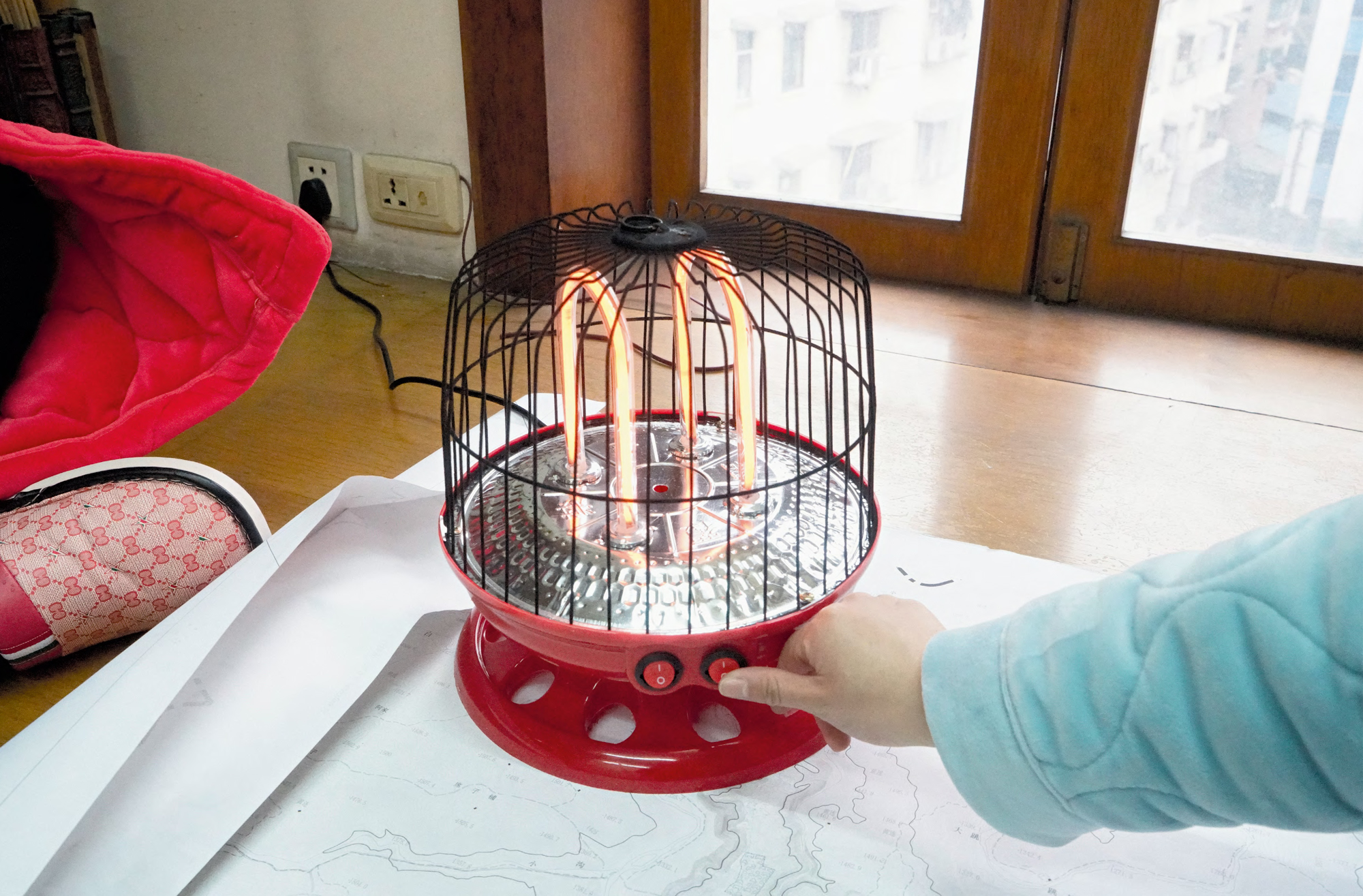
Indoor body-warming techniques, on the other hand, include the use of different heat- radiating objects and devices, as visualized in the staged photographs with residents in a Chongqing apartment. On entering their homes, people grab a warm pullover, padded slippers, handwarmers or a blanket. For instance, Xiaotong, a white-collar worker who often works from home, always has a thermos at his disposal for pouring hot tea every so often. He also uses a heating plate not only to keep food warm but also to warm himself.
How the cold in Chongqing is dealt with depends largely on one’s socioeconomic status. Those of lesser means layer up with clothes or wear quilted pyjamas, the cheapest way to keep warm. As one research participant commented: “The number of quilted pyjamas people wear is an indicator of the social status of a compound. If you walk around in Tiandi [an upper-class residential area], you see only few of them.”
Since the electrification of residential households in the 1980s, Chongqing residents have used electric thermal devices such as air-conditioning units or portable heaters. The sound of these devices adds a monotonous ambient noise to home-making practices. Everyone has their own preferences for devices; sometimes this may be linked to memories. Xiaotong, who immigrated from rural Gansu Province in northwest China, remarked that his mother prefers the heat of the ‘little sun’ (小太阳, infrared heater) because its red colour evokes a sense of cosiness associated with the coal fire in her country homestead. Others dislike infrared heaters because they “make your legs feel numb” due to the intensity of the heat emitted, as one resident explained.
Sensing the Cold 63
collection no. 006 • Senses Roadsides
Katja Jug and Madlen Kobi 64

collection no. 006 • Senses Roadsides
In-BetweenSpace 灰空间 Fog 雾
zap bzzzzzz zap zap
psst
Sensing the Cold
65
collection no. 006 • Senses Roadsides
Slippers 拖鞋 LivingRoom 客厅
The ability to pay for the power needed to run such devices is proportionate to the level of thermal comfort attained. Some affluent members of society can afford to install electric underfloor heating and thus shift the objective of thermal comfort from the individual body to the wider atmosphere of the living space. Those who are not so well off, meanwhile, must warm themselves with less energy-dependent practices. In addition to being a class issue, heating in the south has caused a “comfort generation gap” (Texeira 2019): the younger generation seems less resilient to the cold than the elderly, who have also experienced the era before electrification when indoor spaces were always unheated.
The Heating Divide in China has separated the country into heated north and unheated south, creating a geographically varied biopolitics. In a neoliberal setting, those living in the south have to rely on private means to cover electricity costs for the running of heating devices. The state has effectively put the management of thermal comfort onto the shoulders of individuals (Collier 2011) and thus avoids the huge economic investment required to run a comprehensive heating infrastructure. Leaving Chongqing residents in the cold is also related to mitigating the health-damaging air pollution in China. Saving energy by not providing heating networks aligns with ambitious governmental plans to reduce coal-based carbon emissions. Populations outside of Beijing already suffer from periodic shutdowns of state-run heating installations in order to ameliorate the smog situation in the capital. By paying attention to the sensing of cold in Chongqing apartments, a clear understanding emerges of how individual citizens’ thermal wellbeing is entwined with state decisions on the provision of heating and energy infrastructures.
Acknowledgments:
We would like to sincerely thank our research participants in Chongqing for providing us with sound impressions from their lives (audio files 2, 3, 5, 6). In addition, Asa Roast generously agreed that we could include part of his Chongqing audio recordings (audio file 1), which were released in Bivouac Recording’s “60 Minute Cities” series (https:// soundcloud.com/bivouacrecording/sets/60-minute-cities-chongqing). We also warmly thank Amateur Ambiences for granting permission to use part of the audio track of his Chongqing Walk (https://www.youtube.com/watch?v=Ti6DSEkTYJY) (audio file 4).
Copyright note:
All photographs © 2021 Katja Jug. The photographs in this essay are part of the artist’s project by Katja Jug that culminated in the photobook Frozen Unfrozen: A Poster Novel, where she combined thirty-two images with thirty-two words that emerged as characterizing residential winter life in Chongqing (printed on the left-hand side of the posters). The poster novel was released through edition fink in Zürich.
Sensing the Cold 69
collection no. 006 • Senses Roadsides
References
Collier, Stephen. 2011. Post-soviet Social: Neoliberalism, Social Modernity, Biopolitics. Princeton: Princeton University Press.
Fennell, Catherine. 2011. “‘Project heat’ and sensory politics in redeveloping Chicago public housing.” Ethnography 12 (1): 40–64.
Johnson, Charlotte. 2016. “District heating as heterotopia: tracing the social contract through domestic energy infrastructure in Pimlico, London.” Economic Anthropology 3: 94–105.
Jug, Katja. 2021. Frozen Unfrozen: A Poster Novel. Zürich: edition fink.
Kobi, Madlen. 2020. “Warm bodies in the Chinese borderlands. Architecture, thermal infrastructure, and the materiality of state consolidation in the arid continental climate of Ürümqi, Xinjiang.” Eurasian Geography and Economics 61 (1): 77–99.
Krause, Franz. 2013. “Seasons as Rhythms on the Kemi River in Finnish Lapland.” Ethnos 78 (1): 23–46.
Rahm, Philippe. 2015. Météorologie des sentiments. Paris: Les Petits matins.
Texeira, Lauren. 2019. “Building China: why does half of China struggle to stay warm indoors in the winter?” RADII China. https://radiichina.com/building-china-why-does- half-of-china-struggle-to-stay-warm-in-winter/
Vannini, Phillip et al. 2012. “Making sense of the weather: dwelling and weathering on Canada’s rain coast.” Space and Culture 15 (4): 361–80.
Cite as: Jug, Katja and Madlen Kobi. 2021. “Biopolitics of Heating Infrastructures in Chongqing (China).” Roadsides 6: 62-71. https://doi.org/10.26034/roadsides-202100609
Katja Jug and Madlen Kobi 70
collection no. 006 • Senses Roadsides
Authors:
Katja Jug (kajug.studio@gmail.com, https://www.katejug.net) is a visual artist working with mixed media. Her work comprises staged photographs, installations, happenings and artist’s books. She deals with themes from everyday life such as climate, nutrition and identity. Her latest publication is the photobook Frozen Unfrozen: A Poster Novel, funded by Swiss Arts Council Pro Helvetia. It tells the story of a man and a woman who meet in an unheated apartment in Chongqing, China. Photos, drawings and words are combined into a three-dimensional and multisensorial onomatopoeic experience, depicting how the protagonists live in and around their apartment.
Madlen Kobi is a social anthropologist working at the intersection of anthropology, architecture and infrastructure. She is part of the editorial board of Roadsides and works at the Academy of Architecture of the Università della Svizzera Italiana, Switzerland. As a team member on the project “The City as Indoors: Architecture and Urban Climates” (http://www.roesler.arc.usi.ch), funded by the Swiss National Science Foundation, she is investigating the relations between architecture, socio-technical knowledge, and everyday climate-related practices in residential spaces in Chongqing, China.
Sensing the Cold 71
collection no. 006 • Senses Roadsides
about Roadsides Roadsides is a diamond Open Access journal designated to be a forum devoted to
exploring the social, cultural and political life of infrastructure.
roadsides.net editor@roadsides.net @road_sides @roadsides_journal
Editorial Team:
Julie Chu (University of Chicago)
Tina Harris (University of Amsterdam)
Agnieszka Joniak-Lüthi (University of Fribourg)
Madlen Kobi (Academy of Architecture, Mendrisio)
Galen Murton (James Madison University, Harrisonburg)
Nadine Plachta (University of Toronto)
Matthäus Rest (Max-Planck-Institute for the Science of Human History, Jena) Alessandro Rippa (LMU Munich and Tallinn University)
Martin Saxer (LMU Munich)
Christina Schwenkel (University of California, Riverside)
Max D. Woodworth (The Ohio State University)
Collection no. 006 was edited by: Christina Schwenkel Managing editor: Agnieszka Joniak-Lüthi
Copyediting: David Hawkins
Layout: Chantal Hinni and Antoni Kwiatkowski
ISSN 2624-9081
Creative Commons License